
ASM number 01“How many times left”
You have already spent most of it.
Illustration generated with Google Gemini
Someone of thirty-two, with a mother of sixty-two, who gets home about six times a year. Christmas, her birthday, a week in summer, one weekend that turns up for its own reasons.
Put those three numbers through a standard life table and 122 visits remain. That is the entire supply at the current rate, and it fits on a single screen.
The calculation is the least interesting thing here, because it is about mortality, and mortality is the part everybody already expects. What almost nobody has looked at is the forty years before it, when the same relationship empties out while every person in it is in perfect health.
Fifteen-year-old Americans spend 4.29 hours a day in the company of family. At twenty-five the figure is 1.56. At forty it is 0.80, and for the next forty years it drifts between 0.79 and 1.12 without ever climbing back.
Family there is a bucket, and it is worth opening before the number carries any weight. It holds parents, siblings and other relatives together, and the survey does not publish them apart, so a fifteen-year-old’s 4.29 hours are shared with brothers and sisters as well as with a mother. What the bucket leaves out is cleaner: a partner, your own children and coworkers each have a column of their own.
Nobody has died in that sentence.
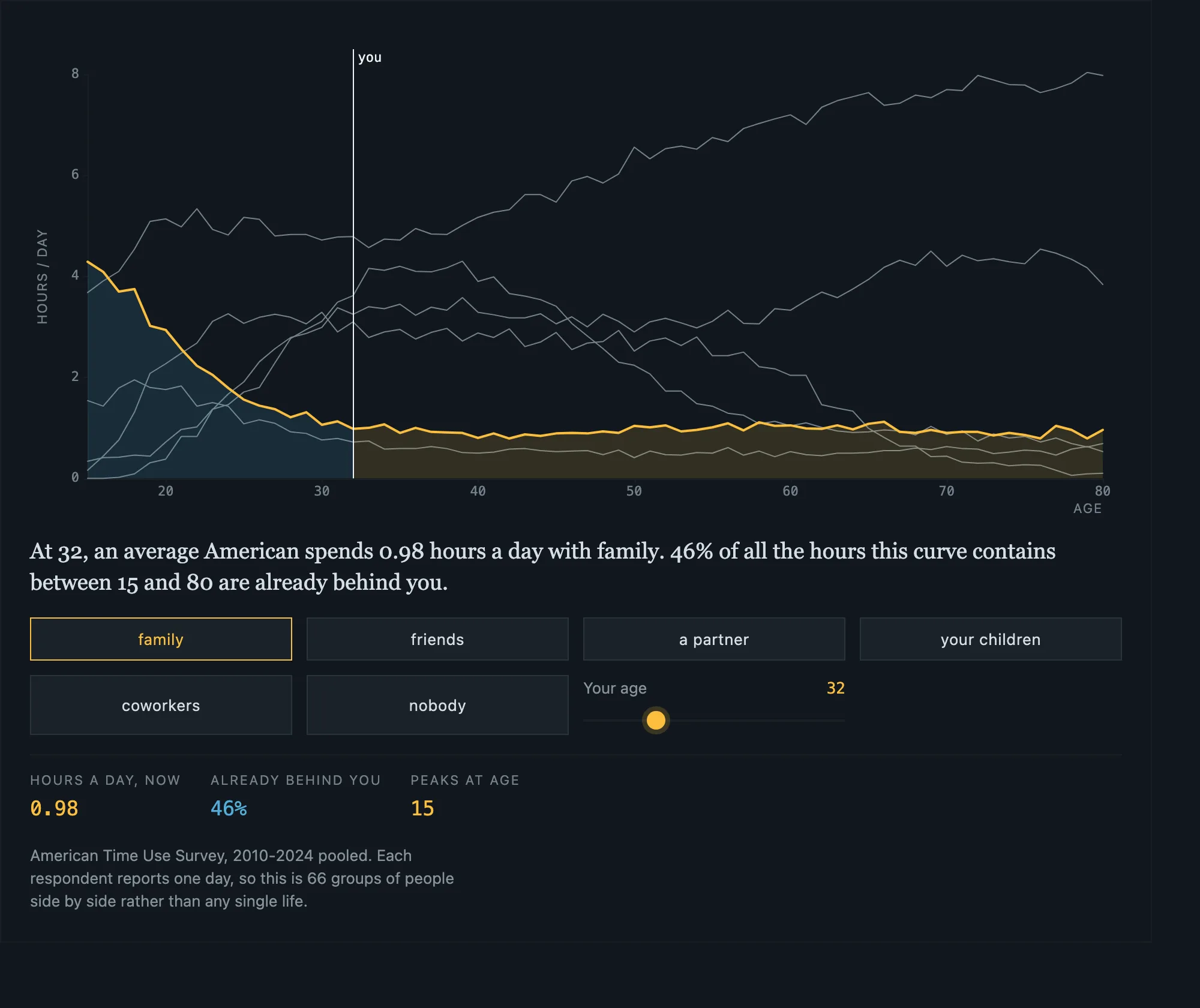
Move the marker to your own age. On most of these curves the shaded part, the part already spent, is the larger part well before anyone would describe themselves as old.
Eighteen is the peak, and almost nothing recovers.
Time with friends tops out at 1.95 hours a day at eighteen. By twenty-five it is 1.08. By forty it is 0.50, and then it does something stranger than declining: it sits there. Half an hour a day, give or take five minutes, for the next four decades.
Retirement does not release it. The friends column at seventy reads 0.63, a shade above the 0.59 it read at thirty-five, and across the whole span from forty to eighty it never leaves the band between 0.41 and 0.63. Whatever people do with the working hours they get back, they mostly do it alone or with a partner.
So the friendship budget of an entire adult life is set somewhere around twenty-two, and the setting holds. That is a strong claim from one survey, and there is a published measurement that complicates it. Across 277 studies and 177,635 people, friendship networks shrink while family networks do not.
Size and hours are different quantities, and they come apart here. The number of people someone would name as family holds steady from adolescence to old age. The number of hours spent in a room with them falls by 81% between fifteen and forty. A relationship can survive intact as a fact about who exists and still lose almost all of its actual duration.
The hours did not disappear. They were reassigned.
Between fifteen and thirty the family column falls by 3.2 hours a day. Over the same stretch, partner, children and coworkers together add 8.9 hours a day between them.
That is more than a day contains, because the survey counts a person once for every companion in the room. A dinner with a partner and two children counts three times. The arithmetic still shows the direction: nothing is lost to idleness, and the hours go somewhere specific and largely admirable.
Time with a partner goes from zero at fifteen to 2.99 by thirty. Time with coworkers goes from 0.16 to 3.29. Time with children rises to a peak of 4.30 hours a day at thirty-nine, the single largest number in the whole dataset.
Then that one falls too. By sixty it reads 1.04, which is 24% of the peak and almost exactly where the family column sat at thirty. The thing that took the hours from your parents does the same thing to you on the same schedule, about thirty years later.
Underneath all of it, one line moves in a single direction. Time alone is 4.72 hours a day at thirty and 7.98 at eighty, and between those ages no single year falls by more than fifteen minutes and no reversal lasts. It is the only category in the survey that behaves that way.
Put your own people in it.
Two ages and a frequency are enough. The widget below computes, for every future year, the probability that both people are still alive, and adds those probabilities up. Each dot is one meeting, drawn at the odds it actually happens.
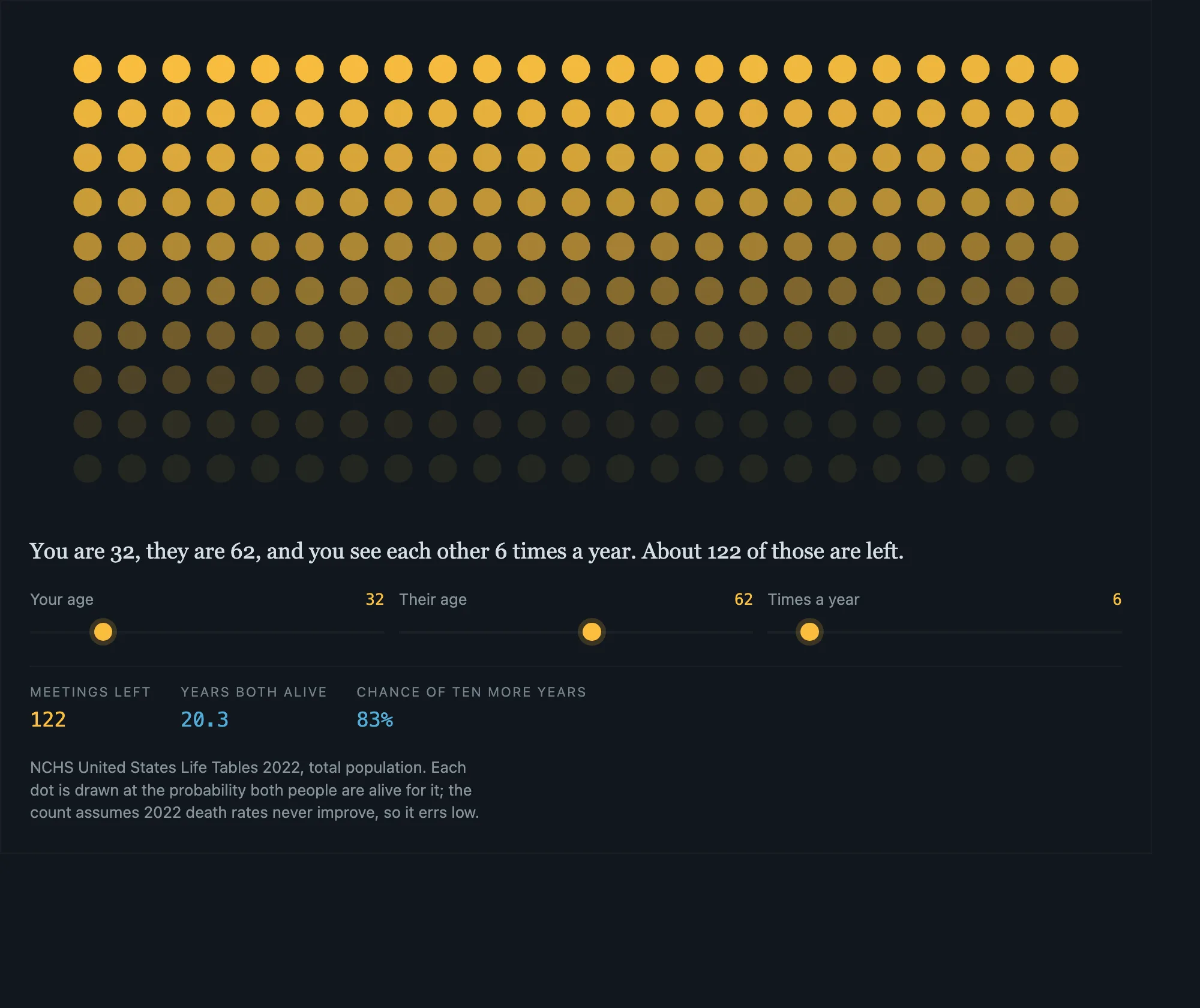
Two things about that grid. The dots at the end are pale because they are unlikely. The total underneath is an expectation with a wide spread around it, not a promise.
And a period life table freezes 2022 death rates in place forever, so it quietly assumes medicine stops improving. For a sixty-two-year-old that is a real understatement, probably a year or two of life expectancy. The correction moves the count by a handful of visits. It does not move the order of magnitude, which is the thing worth looking at.
Raising the frequency moves it much further than any assumption about mortality does. That is the only actionable fact in this article and I am going to leave it as an observation about the model rather than dress it up as advice.
Most of this could be wrong, and here is how.
The American Time Use Survey interviews a person once, about one day, and never again. The lifespan curve is 66 different groups of people standing next to each other, which means it mixes the effect of ageing with the effect of having been born in a different decade. The source says so in its own documentation, and the friendship meta-analysis found exactly that confound in its own data: personal and friendship networks have been shrinking across the 35 years its studies span, independently of anyone getting older.
If the eighty-year-olds in this data always saw less of their friends, the curve is partly a photograph of the twentieth century rather than a map of a life.
There is a measurement of how large that confound can get. Reading the same survey by calendar year instead of by age, and counting social engagement rather than mere presence in a room, time with friends fell from 60 minutes a day in 2003 to 34 in 2019. Sixteen years, 219,368 diaries, and nobody in that comparison got older. It is a different measure from the one this article has been quoting and cannot be subtracted from it, but a period effect that size is a warning about how much of an age curve is age.
The sharpest form of the objection is a study that separated the three. Following 3,481 people first sampled in East Baltimore in 1981 through 1993, 2004 and 2021, with age, period and cohort modelled at once, no age effect on family or friend network size was detected at all. Network size is not hours, and one city over forty years is not the country. It is still the best attempt anyone has made to ask whether the decline is ageing, and the answer came back no.
There is a second limit, and it sits in the definition. “With” means present in the room. A two-hour phone call to a parent counts as two hours alone. For a generation that maintains relationships mostly through a screen, that is not a small measurement error, and it runs in the direction that makes the article’s case look stronger than it is.
The objection that would actually sink this article is about what the narrowing means. Under socioemotional selectivity theory it is a preference. As the sense of remaining time shortens, people drop peripheral ties on purpose and keep the ones that matter, and the result is a better emotional life rather than a poorer one. Sampled five times a day for a week, three times across ten years, older adults reported better and steadier emotional lives than younger ones, and that survived controls for personality, health and demographics.
That evidence has 184 people in its first wave, comes from one metropolitan American sample, and rests entirely on self-report from a cohort that was dying during the study. It is still the strongest reading available of the same curve, and it is the reading I would have to be wrong about for this article to matter.
Pointing the other way, isolation is not neutral for how long people live. Pooled across the literature, social isolation carries 1.29 times the odds of dying over follow-up, loneliness 1.26, living alone 1.32, adjusted. The widely quoted 50% survival advantage is the same team’s earlier and larger estimate, and their own later work walked it down, which is the direction honest revisions usually go.
Both of those are observational, so illness isolates people as surely as isolation sickens them, and the authors say the initial health of the sample changes the answer.
The last one is not announced.
Nothing in the data says a shrinking social life is bad, and I have no measurement of whether anyone notices the moment a relationship’s hours run out. That measurement would need to exist for this article to make the claim it is obviously reaching for, and it does not exist, so the claim stays unmade.
What the numbers do support is narrower and harder to argue with. The decline is early, it is steep, and it happens for reasons that at the time look like a life going well: a job, a partner, a child, a flat in another city. Every one of those is the correct decision. Together they take about four fifths of the hours.
The second thing is that the total is finite and roughly knowable, which for anything that matters this much is unusual. Most of what matters cannot be counted. This can, from two ages and a number of visits a year, and almost nobody has ever run it.
I ran it while writing this, for my own parents, and the figure was smaller than the one I opened with. I have not changed how often I go. I now know what the number is, which turns out to be a different thing from being told that time is short.